Thursday, March 16, 2017
2017 Topps Opening Day: Cheap thrills
I'm going to a card show tomorrow, so there's really no reason I should be buying cards today.
Even more of a deterrent to buying anything before tomorrow is the fact that I have a large box sitting on my living room table full of cards that still need to be filed away from the two shows I attended last month.
But rarely does the sight of baseball cards foster rational thoughts. I was in a Target today, and even though I did my best to close my eyes and mumble REMEMBER THE CARD SHOW! over and over again to myself, I still wound up in the card aisle.
It was then I saw a fresh stock of the newest set on the shelves: 2017 Topps Opening Day.
It felt almost out of my control when my hand reached for the blaster, two rack packs, and single loose pack I ended up purchasing.
With any other brand, an impulse purchase of such quantity could've destroyed my bank account. But you know what the best part about Opening Day is? All told, my bill was slightly over eighteen dollars total, which is less than a single blaster of most brands these days.
Such affordability has always been Opening Day's premier selling point.
By now, you probably know what to expect from Opening Day: Flagship rehashings, some Series 2 previews, and a couple guys in new photoshopped jerseys thrown into the mix for good measure.
The base cards in Opening Day carry less of a punch than ever now that Topps has gone foil-less. There's literally no difference between these cards and Flagship besides the special Opening Day stamp. This is why it'd be difficult to express why I still buy Opening Day to non-collectors: it's basically like buying doubles most of the time.
Best I can put it, I buy Opening Day because it's there.
If the packs were all base cards, I doubt I'd still be an Opening Day consumer.
But there's far more to this brand than just the redundant base checklist. In fact, Opening Day is really the only set that I mainly buy for the supplementary fun. Among the bonus goods this year are these nifty blue parallels.
When the Trout fell out of one of the first packs of the blaster, I thought to myself: Man, I seem to have awfully good luck at pulling Trout stuff.
Just a few packs later came my only "Opening Day Stars" insert of the lot, which features, you guessed it: Mike Trout, who looks like he was a direct result of the Big Bang (or something to that effect) on this design.
Mascot inserts have always been a Opening Day staple, and they continue to be here in 2017.
I've never seen that Brewers mascot before (does he/she/it even have a name?) but it creeps the hell out of me for reasons I can't quite put my finger on right now.
Yes: there's actually an insert series in Opening Day called "Opening Day," which features panoramic shots from various Opening Days around the bigs.
Perfect for my "anthemic" mini-collection since the "National Anthem" inserts in this set are painfully short-printed thanks to some harebained Topps scheme and therefore impossible/expensive to track down.
Perhaps the most refreshing add to Opening Day's stable of insert sets is this year's "Incredible Eats" series, which features some of the most delicious dishes MLB ballparks have to offer.
I can hear my stomach rumbling already.
Finally, we've come to probably my favorite insert set in the hobby today: Superstar Celebrations.
And this one just so happens to feature the greatest celebration of them all, the exact moment the Cubs -- and Anthony Rizzo -- became World Champions. All I can say is that we might just have a new member in the running for Card of the Year.
At this point, Opening Day is never going to elevate itself to the top of the hobby, at least not while it's basically just Flagship Recycled. But as I've said year in and year out, it's still good for some cheap thrills, and cheap thrills are becoming harder and harder to find in the current hobby.
I'm going to be surrounded by flood lights, high-end dealers, and four-figure cards at the show tomorrow. It's a fun -- yet overwhelming -- experience. I needed some calm before the storm, and Opening Day certainly answered that call this afternoon.
Sometimes a quiet dose of Opening Day in the comfort of your own room is the best medicine.
Saturday, March 11, 2017
Top Five: Jim Abbott
Personally, I get a little uncomfortable with how often the word "hero" gets thrown around in sports culture.
It seems to me that too often the line between fan and hero is blurred to the point where some can't tell which is which. Declaring someone a "hero" is a big statement, but I'd be the first to admit that I've been guilty saying things like this without a second thought in the past.
With all the other avenues available these days, you'll probably be disappointed if sports are your only pathways for inspiration. But that's definitely not to say that athletes can't be heroes. One person I feel comfortable calling a "hero" in my life is Jim Abbott. You probably know his story by now: Abbott enjoyed ten fruitful years in the bigs despite being born without a right hand.
I own north of 100 cards of Abbott -- largely thanks to the fact that his career fell smack dab in the middle of the overproduction era -- so I certainly had a lot of decisions to make in whittling things down to a surefire Top Five this week.
#5 -- 1991 Upper Deck #554 Jim Abbott
We lead off with a perfectly odd card for my odd collection.
Jim Abbott spent nine of his ten big-league seasons in the American League and never once took an at-bat in any of those nine years. It's strange, then, that his 1991 UD issue features him at the plate in what I can only assume is a Spring Training shot (at what looks to be Dodger Stadium).
Adding to the madness is the fact that, as the back of the card tells us, Abbott somehow managed to get on base.
#4 -- 1989 Topps #573 Jim Abbott RC
This may well have been the first Jim Abbott card I ever owned.
I vividly remember it causing me much consternation as a young card collector. How can a guy in a college uniform get a Topps baseball card?, I wondered. It didn't make any sense.
Turns out Topps was right on the money here since, in 1989, Abbott became one of a small number of players to jump directly to the big leagues without playing a single minor league game.
#3 -- 1994 Score #626 Jim Abbott HL
In perhaps the crowning moment of his career, Jim Abbott pitched a no-hitter against the Indians on September 4th, 1993.
This magnificent highlight card documents the occasion with a great shot of Abbott tipping his cap to the Yankee faithful after the historic event.
#2 -- 1999 Upper Deck #409 Jim Abbott
This could also have been the first Jim Abbott card I ever owned (my memory's a little fuzzy when it comes to my early collecting years).
Abbott's final season came with the Brewers -- his first National League team -- in 1999. The move to the NL, of course, meant that Abbott had to step into the batter's box for the first time in his career, an unorthodox sight which is documented on his sunset card from Upper Deck.
Again, my young collecting self had a question about a Jim Abbott card: How can a guy with one hand swing a bat?
For the record, Abbott collected two hits in 21 at-bats as a Brewer -- including a two-run single I could watch on repeat for the rest of my life.
#1 -- 1989 Upper Deck #755 Jim Abbott RC
I've gone on record as saying that this is the greatest rookie card ever made, and I stand by that statement.
Upper Deck must have sensed that Abbott was something special early on since they rewarded him with this beautiful horizontal, multiple-exposure shot. And yes, I repeat, this is a rookie card. Guys didn't usually get the multiple-exposure treatment until they were established superstars -- at least back when card companies still did the multiple-exposure thing.
I've been a fan of many players throughout my baseball lifetime, but only a small fraction of them have become heroes.
In the end, I feel comfortable saying that Jim Abbott is, without any doubt, a hero.
Thursday, March 9, 2017
Fate, customs, and Disco Demolition Night
So here's something fun that happened at work the other day.
As a bookstore clerk, I get a rush whenever someone asks me for a book recommendation. It breaks the monotony of ringing items up and saying Have a nice day hundreds of times per shift. Last weekend, I was presented with perhaps the greatest question of them all from what seemed like an ordinary customer: Got any books about baseball?
Since we were out of Cardboard Gods (one of my staff picks), my mind instantly jumped to a local-press book my store carries: Disco Demolition: The Night Disco Died. It's basically an oral history of the infamous Disco Demolition Night fiasco. I haven't read the whole thing, but I've flipped through a good portion of it during downtimes at work.
So, anyways, I recommended it to this customer, and he looked back at me and said, without missing a beat: I wrote that book. Turns out the customer in question was Dave Hoekstra, who co-wrote the book with Steve Dahl -- the Chicago deejay behind Disco Demolition Night (along with Sox owner Bill Veeck).
Mr. Hoekstra was at Comiskey that fateful night -- July 12, 1979 -- and we chatted for a bit about the event. He was one of the real fans at the ballpark that evening. One of the first things he told me was how upset he was that the second game of the scheduled doubleheader was cancelled and forfeited to the visiting Tigers. In the end, he signed the copy of his book we had in stock, took a picture of me with it (for promotional/social media purposes), and went on his merry way.
The whole rest of the day, I kept thinking to myself: What were the odds that I'd recommend a book to the very author who wrote it?
It must have been fate for more reasons than one: the very next cards in my trade folder were a batch of terrific self-made customs sent to me from Jeremy of the "Topps Cards That Never Were" blog.
Among the customs Jeremy so generously printed out for me was, you guessed it, one documenting none other than Disco Demolition Night. Not surprisingly, no actual card has ever been made of the event. It's not exactly a shining moment in the annals of baseball, music, or American society as a whole.
Even so, I've always had a fascination with anything and everything regarding Disco Demolition Night, so I'm glad Jeremy added this custom to my collection.
Here's more awesome customs from Jeremy, including Eddie Gaedel, another one of Bill Veeck's promotional brainchilds (brainchildren?).
Also present were Jose Canseco's ill-fated inning on the mound and a couple Sunset Cards That Never Were with Teke and Jim Abbott, both of which depict the unfamiliar stints that ended their careers.
Jeremy went heavy with the custom-sunsets, adding another bunch of unfamiliar finales featuring Murph as a Rockie, John Olerud as a Red Sock, and Vlad as an Oriole.
I own several Griffey Sr./Griffey Jr. combo cards, but Jeremy's is the first one I've seen that actually documents their historic night of back-to-back homers.
Rounding out the customs was yet another Sunset Card That Never Was with this 1991 Topps-themed Billy Buckner.
It mostly gets lost to history these days, but Buckner actually returned to Boston for his final season in 1990, which is shocking when you consider the fact that it'd only been four years since his infamous World Series blunder.
Aside from a scarce, impossible-to-find oddball, I'm fairly positive that no cards exist of Buckner's second term with the Red Sox, which means that adding this one to the binders closed a gaping hole in my sunset collection. Plus, in another twist of fate, Jeremy just posted this very card on his blog last night. Again: what are the odds?
Whether at work, with trade packages, or in life, I'm starting to believe fate is a very real thing.
Tuesday, March 7, 2017
2017 Topps Heritage: Unleash the burlap
If there were ever a year I was going to dislike Heritage, this would be it.
2017 Topps Heritage, as you probably know, is honoring the infamous 1968 burlap design. It's not a particularly popular one amongst collectors, and I myself have never cared for it. In fact, I'd probably rank '68 as my least favorite vintage Topps design (though I go back and forth between '68 and 1970).
No matter the design, however, Heritage remains a must-buy for me, and I finally scored some from my local Target this weekend. Like I did with 2017 Flagship, I opted for a full retail extravaganza, purchasing a loose pack, a rack pack, a hanger box, and a blaster on Saturday.
I opened the first pack and prepared myself for a flurry of burlap.
There it was: burlap-o-rama.
It's even more jarring to see such borders in this day and age because burlap strikes me as a very grandfatherish material. I can't say I have much burlap in my life these days, and I'm not especially bummed about that.
I will, however, give credit where credit's due: '68 Topps was the first Flagship set to feature anything other than a plain, white border, a daring move that paved the way for future great colored-border designs like '71 and '75 Topps. And the backs are terrific, as per usual from vintage Topps.
But in the end, Heritage most assuredly did not change my feelings towards the burlap: ick.
For comparison's sake, here's a real '68 Topps next to a Heritage knock-off, both featuring exciting young Cubs infielders.
Now that '68 Topps is in the mainstream again, I'm learning things about it left and right. For example: I never realized the burlap borders had variations before 2017 Heritage came along. As you can see on the Kessinger (and the Kershaw), the dots are spaced closer together than they are on the Baez.
It's not a particularly exciting discovery, but it's a discovery nonetheless, and I'm always eager to increase my cardboard IQ.
Heritage is often the first time we get to see players involved in offseason transactions in their new uniforms.
Photoshopping has been shaky in some past Heritage releases, but judging from this quartet, whoever was in charge of it this year was absolutely on point.
Subsets are abound in this year's Heritage, and the World Series cards are particularly exciting for me because they happen to feature the best (and most rewarding, obviously) Fall Classic I've seen in my life as a baseball fan.
I may not be the biggest '68 Topps fan, but I do love the black-and-white, TV-esque design of the World Series subset.
In yet another example of Topps sticking it to us lowly low-end collectors, they've increased the number of SPs in 2017 Heritage from their usual 75 to a whopping 100 (card numbers 401-500) this year.
Makes me glad I'm not much of a set collector, although it does get tiring trying to track down short-prints of players I chase. Tulo is one down and about fifty more to go.
I, unfortunately, do not collect Khris Davis, but I do like the Flower Power look of the "New Age Performers" inserts this year.
Cubs hot packs!
I'll resume my excitement over that once Jake Arrieta is done staring into my soul.
To close on a non-baseball note, here's the first notch in my yearly quest to complete Heritage's "News Flashbacks" insert set.
Like the short-prints, Topps has upped the number of these from ten to fifteen. Unlike the short-prints, I'm happy about that decision because it makes logical sense. I've learned enough about history to know that 1968 was a particularly historic and turbulent time for the world -- and especially America -- so it stands to reason that more events would be documented in this year's Heritage.
All in all, I think 2017 Heritage did exactly what Heritage is supposed to do: faithfully honor a classic Topps design. No matter my feelings for the burlaps, '68 Topps is indeed classic, and this year's Heritage still provides the usual excitement of seeing current players on an old design.
But I think most of us would agree that burlap was best left in the '60s.
Wednesday, March 1, 2017
Short Term Stops: The All-Phillies Team
I don't know if there's a team I'm more neutral about than the Philadelphia Phillies.
When it comes to the Phillies, I just...don't really care. I don't say that to sound harsh, it's just that the Phils, for whatever reason, have never much registered on my baseball radar.
They've never had any of my favorite players. Unless they're playing the Cubs, I rarely watch them. Even their good teams -- including the 2009 World Championship squad -- never captivated my interest. They're not super relevant record-wise these days, either. When you add all that up, you get apathy.
But they do have one thing going for them: the Phillies have an absolutely loaded Short Term Stops roster, so let's get to it.
Pitchers
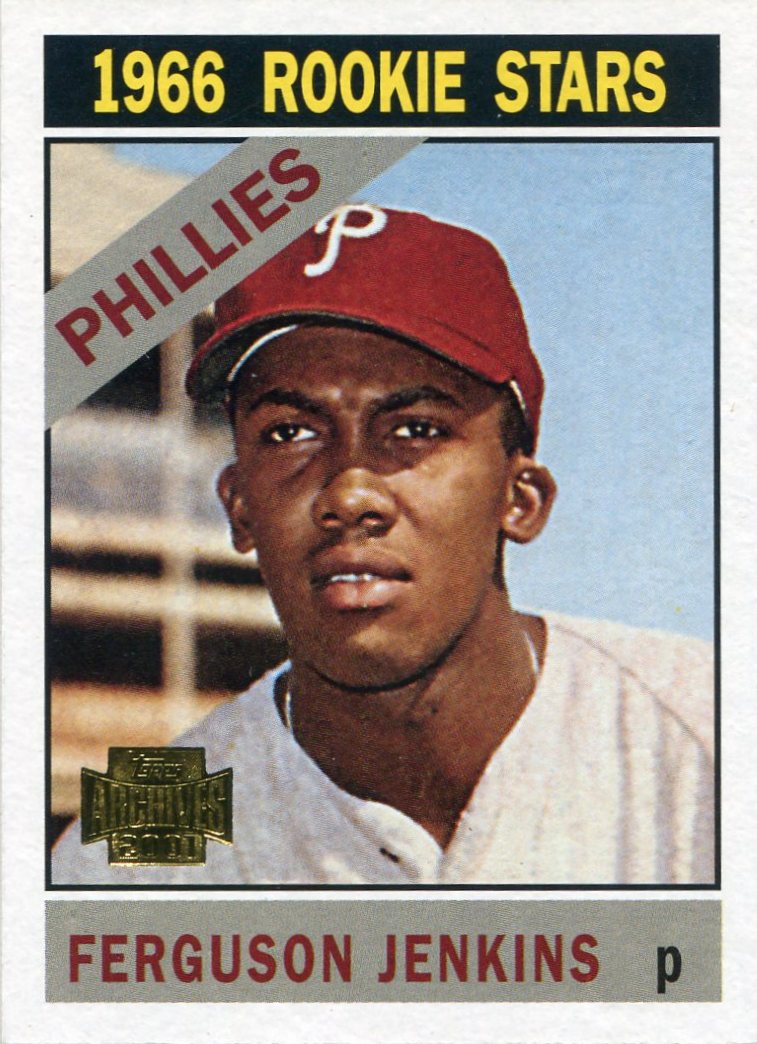
2001 Topps Archives #275 Fergie Jenkins
Phillies "Short Term Stops" Accolades:
Fergie Jenkins (1965-66 Phillies, 8 games)
If nothing else, the Phillies have an impressive track record of (unintentionally) stocking the Cubs' roster with future stars.
In one of the worst trades in Philadelphia history, the Phils dealt a young hurler named Ferguson Jenkins to the Cubs for pitcher Larry Jackson at the beginning of the '66 season. Jenkins had pitched in just eight games over the course of two separate cups of coffee as a Phillie, collecting his first two career wins and first ten strikeouts with the club.
Jackson would be out of baseball by the following year and -- as we all know -- Fergie would go on to a Hall of Fame career as the ace of the Cubs' pitching staff for many years to come, including an unthinkable run of six straight 20-win seasons from 1967-72.
Still, that was only Part One of the dubious Phils-Cubs saga...but more on that later.
1995 Collector's Choice SE #168 Fernando Valenzuela
Fernando Valenzuela (1994 Phillies, 8 games)
Fernando-mania looked to be all but over by the time Valenzuela became a Phillie.
The 34-year-old Fernando wasn't signed until June of the '94 season and would get into just eight games (seven starts) in Philadelphia, going 1-2 with a 3.00 ERA before the strike hit. Valenzuela didn't seem to have much left in the tank, but he'd prove everyone wrong by having a couple fine years with the Padres and hanging around the bigs until 1997.
He'll always be a Dodger in the minds of the vast majority of baseball fans, but you can't dispute the photographic evidence that Fernando Valenzuela was once a Philadelphia Phillie.
2009 Topps Heritage High Numbers #563 Pedro Martinez
Pedro Martinez (2009 Phillies, 9 games, sunset season)
Here's one of the better Short Term Stops in recent memory.
A late-season sign in 2009, Pedro provided a veteran presence on a Phillies team headed to the World Series, going 5-1 with a 3.63 ERA in nine starts down the stretch. He lost two games to the Yankees (his daddy) in the '09 Fall Classic, which the Bronx Bombers would take in six.
Pedro retired shortly after the 2009 season, leaving us with a Hall of Fame career and the forever unfamiliar sight of him in a Phillies cap.
Catcher
1967 Topps #326 Bob Uecker
Bob Uecker (1966-67 Phillies, 96 games, sunset season in '67)
Bob Uecker remains the most famous .200 hitter in baseball history.
Mainly utilized as a backup catcher, Uecker posted a .202 average with seven homers in parts of two years with the Phillies before being traded to the Braves -- his original team -- midway through the '67 season, where he'd finish his career.
Of course, we'd all get to know Uecker a little better via his alter ego: Harry Doyle.
First Base
2010 Topps National Chicle #280 Jimmie Foxx
Jimmie Foxx (1945 Phillies, 89 games, sunset season)
Here's one of the best (and often untold) stories from baseball's War Years.
Hobbled by injuries and too old to serve in World War II, Jimmie Foxx suited up for the Phillies in what would be his final big league season in 1945. The 38-year-old didn't have much left in the tank, as he'd hit just seven homers (the last of his 534 career dingers) in 89 games in Philadelphia.
What remains interesting about Foxx's time with the Phillies, however, is that, thanks to depleted rosters due to the wartime effort, Double-X wound up pitching for the club. We're not talking a late-inning stint in a blowout here, either. The future Hall of Famer went 1-0 in nine appearances (22 innings) with a nifty 1.59 ERA for the '45 Phils.
Looks like Double-X might have to do double duty on this roster.
Second Base
1994 Topps Traded #130T Ryne Sandberg
Ryne Sandberg (1981 Phillies, 13 games)
Fifteen years after the infamous Fergie Jenkins trade, the Phillies unwittingly provided the Cubs with yet another future Hall of Famer: Ryne Sandberg.
As the story goes, the Cubs got Ryno as a "throw-in" with Larry Bowa in return for shortstop Ivan De Jesus, who the Phils had been coveting for years. A late-season call-up with the '81 Phillies, Sandberg went 1-for-6 in 13 games before being traded.
The remaining 2,385 hits of his Hall of Fame career would, of course, be collected over the course of 15 star-studded seasons on the North Side of Chicago.
Shortstop
1983 Donruss #525 Julio Franco RC
Julio Franco (1982 Phillies, 16 games)
Here's the ageless wonder himself: Julio Franco.
Franco's career would famously last until 2007 -- when he was a ripe 49 years old -- but it all began way back in 1982 during a cup of coffee with the Phillies. He hit .276 in 16 games in Philadelphia before being traded to the Indians the following offseason and becoming one of the more underrated hitters of his generation.
As far as I know, Donruss was the only card company to commemorate Franco's brief stint as a Phillie, so kudos to them.
Third Base
2013 Bowman #31 Michael Young
Michael Young (2013 Phillies, 126 games, half-year stint, sunset season)
After spending the first thirteen years of his big league career as a Texas Ranger, Michael Young was traded to the Phillies prior to the 2013 season.
Young would go on to hit .276 with eight homers in 126 games for the Phils before being dealt to the Dodgers in a late-August waiver trade. He'd retire at the close of the season.
It's still a little shocking to see Michael Young in anything other than a Rangers uniform.
Outfielders
1997 Score #448 Danny Tartabull
Danny Tartabull (1997 Phillies, 3 games, sunset season)
On a roster stocked with unusually short stints, Danny Tartabull earns the distinction of being the shortest-tenured Phillie on this squad.
Tartabull spent all of three games with the Phillies during what would turn out to be his sunset season in 1997, going hitless in seven at-bats.
Tartabull was a fine hitter in his day, but I (like many others, I'm sure) instantly think of Seinfeld whenever I hear his name.
2005 Topps Total #8 Kenny Lofton
Kenny Lofton (2005 Phillies, 110 games)
Here's Kenny Lofton, perhaps the premier Short Term Stops legend.
Lofton landed with the Phillies for the 2005 season, the ninth of eleven teams he'd go on to play for in his long career. It was a stellar campaign for the speedster, as he hit a sparkling .335 in 110 games for the Phils -- with 22 steals tacked on for good measure.
Put those numbers together with the fact that Lofton was 38 years old at the time, and you have what is easily the most impressive season for any member of this roster.
2009 Upper Deck #295 Geoff Jenkins
Geoff Jenkins (2008 Phillies, 115 games, sunset season)
You don't hear his name thrown around too often these days, but I sure was surprised to find out that Geoff Jenkins ranks fourth on the Brewers' all-time home run leaderboard while researching for this post.
Jenkins's underrated career went out with a bang as well. After spending the first ten years of his baseball life as a Brewer, Jenkins would sign with Philadelphia for the 2008 season, hitting .245 with nine homers for a Phillies club that would go on to win it all.
Jenkins decided to hang 'em up while he was still on top, bringing his underrated and perhaps overshadowed career to a distinguished end.
That just about does it for this edition of "Short Term Stops."
Thanks for tuning in.
Tuesday, February 28, 2017
Anatomy of the Dime Box Dozen
I was lucky enough to win a contest emceed by Matt of "Bob Walk the Plank" fame a while back.
Winning any kind of contest is an unexpected treat for me, as I usually have rotten luck when it comes to those types of things. It's the reason I almost never play any incarnations of the lottery.
But I was especially excited to emerge victorious from one of Matt's contests, because he's famous around the blogosphere for putting together legendary stacks of cards to send to people. I waited eagerly by my mailbox for the winnings to arrive, and boy was I ever excited when the package showed up.
The spoils started out harmfully enough: Matt knocked off a hefty chunk of insert needs from years past, including this terrific "Glove Stories" GQ insert of Bryce Harper.
More various Topps inserts crossed off the various want lists.
Also included was a stack of a few dozen 2013 Gypsy Queen base cards I needed.
Check that, these are actually from 2014 Gypsy Queen: the designs have really started to blend together in my head over the years.
But all that was small potatoes in comparison to the meat of my contest winnings from Matt, because inside the package, I found a grand total of ten cards from my Dime Box Dozen list.
That is, for the mathematically inclined, 83 percent of my DBDs knocked out in one fell swoop, which shattered the record for the most DBD needs crossed off by a single package. I couldn't believe it. I've scanned each of the ten suspects individually -- beginning with Larry Bowa here -- and have included small blurbs about my motivations for acquiring each of them in order to get to the real anatomy of my Dime Box Dozen list.
The Card: 1985 Donruss #361 Larry Bowa
On the Dime Box Dozen because: This was the final card I needed to complete my sunset collection of Mr. Bowa, plus it features a pretty awesome Wrigley Field shot.
The Card: 1986 Donruss #648 Cesar Cedeno
DBD because: Once again, another example of a Donruss card standing of the way in my completion of a sunset collection. Also, bonus points for chronicling Cedeno's short stint as a Cardinal, though he'd actually close his career with a card-less stint with the '86 Dodgers.
The Card: 1989 Upper Deck #667 Orel Hershiser WS
DBD because: Just a cool highlight-themed card I needed to secure for my growing Bulldog collection.
The Card: 1991 Stadium Club #70 Ozzie Guillen
DBD because: Sometimes even overproduction-era cards somehow slip through the cracks, as this terrific throwback shot of Ozzie had for my entire collecting lifetime.
The Card: 1999 Ultra #35 David Wells
DBD because: An all-around masterpiece featuring a heroic, movie-esque shot of Boomer following his legendary perfect game in the Bronx.
The Card: 2003 Topps Fan Favorites #50 Cal Ripken Jr.
DBD because: This was the DBD need I was most excited to receive from Matt, in no small part because it'd been sitting on my list for around a year. It's the only card I've ever seen that features the Orioles' version of MLB's doomed Turn Ahead the Clock promotion.
The Card: 2004 Topps Total #778 Eric Karros
DBD because: Another long-awaited sunset card featuring Eric Karros's brief and wildly unfamiliar stint with the A's.
The Card: 2013 Topps #134 Jake Arrieta
DBD because: A pre-fame image of the Cubs' current ace and an annoying example of a card I'd accumulated several parallels of without owning the regular ol' base card.
The Card: 2014 Stadium Club #3 Babe Ruth
DBD because: More than any other player I can think of, Babe Ruth suffers from having the same three or four photos recycled over and over again on his baseball cards. This SC single features a refreshing new image of the Babe that I'd never seen before, one that shows his popularity among baseball fans everywhere.
The Card: 2015 Topps Update #US-46 David Price
DBD because: I opened a hobby box and several retail packs of 2015 Update, and this was the only card I needed that somehow eluded all that wax. Thanks to Matt, David Price, the pesky straggler, finally became mine.
If you want to talk about a trade package perfectly customized to fit my collecting needs, look no further than this one. And all I had to do was type my name into a comment box, because card contests are a beautiful thing.
Safe to say that it took my Dime Box Dozen list had to take some time to recover after that vicious attack from Matt.
Subscribe to:
Posts (Atom)